

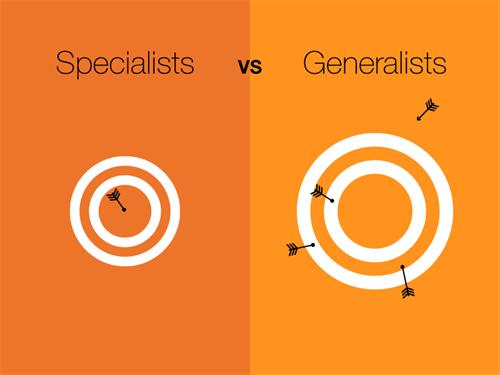
For decades, career advice often sounded simple: become an expert in something valuable. The logic was straightforward. Specialists—people with deep expertise in a narrow field—were seen as indispensable. Surgeons, software engineers, financial analysts, and research scientists all built careers on the power of specialization.
Yet the modern workplace is changing rapidly. Automation, artificial intelligence, remote work, and shifting economic conditions are reshaping what employers need. In response, a competing philosophy has gained momentum: the rise of the generalist.
Generalists are individuals with broad knowledge across multiple domains, capable of adapting, learning quickly, and connecting ideas across disciplines.
So which career strategy is stronger today?
Should workers focus on deep specialization, or cultivate broad versatility?
The answer is more nuanced than choosing one over the other. In many modern industries, the winning strategy lies somewhere in between.
The Historical Advantage of Specialists
Specialization has long been associated with economic productivity and professional prestige.
The logic dates back centuries. In economics, the concept of the division of labor suggests that productivity increases when workers focus on specific tasks. As industries became more complex, specialization became essential.
In the 20th century, the modern corporate world reinforced this model:
- Engineers specialized in specific technologies.
- Doctors focused on narrow medical fields.
- Lawyers concentrated on particular legal domains.
- Academics pursued highly specialized research areas.
This structure offered several advantages.
1. Deep Expertise Creates Value
Specialists develop rare, high-level skills that are difficult to replicate.
A cybersecurity expert who understands advanced network vulnerabilities or a neurosurgeon capable of performing delicate brain operations possesses knowledge that requires years of training. Such expertise often commands higher compensation.
2. Clear Career Identity
Specialization provides a clear professional identity.
It is easier to describe and market yourself when your role is well-defined:
- “I’m a tax lawyer.”
- “I’m a machine learning engineer.”
- “I’m a pediatric cardiologist.”
Employers often prefer candidates who fit clearly into established roles.
3. Efficiency in Complex Systems
Large organizations depend on specialists to manage complexity. A global company may employ thousands of workers, each responsible for a particular function—from logistics optimization to regulatory compliance.
In such environments, specialists keep systems running smoothly.
For decades, this model worked exceptionally well.
But modern work is beginning to challenge it.
Why Generalists Are Gaining Attention
In today’s rapidly changing economy, adaptability has become a critical skill. Industries evolve faster than ever, and roles that existed ten years ago may disappear or transform.
This has led to growing appreciation for generalists.
1. Technology Is Blurring Professional Boundaries
Technology increasingly connects fields that were once separate.
For example:
- Marketing now requires data analytics.
- Healthcare involves digital platforms and AI diagnostics.
- Journalism increasingly requires multimedia production and data visualization.
- Finance professionals often need programming skills.
Professionals who understand multiple disciplines often perform better in these hybrid environments.
2. Innovation Often Happens Between Fields
Many breakthroughs occur at the intersection of disciplines.
Consider examples such as:
- Bioinformatics (biology + computer science)
- Fintech (finance + technology)
- Digital health (medicine + software engineering)
Individuals who can connect ideas across fields are often better positioned to identify new opportunities.
Generalists may not always possess the deepest expertise in a single domain, but they often excel at seeing patterns and linking concepts.
3. Career Stability in Uncertain Times
Economic uncertainty and automation have made long-term career stability less predictable.
Workers who rely on one narrow skill may face greater risk if that skill becomes obsolete.
Generalists, by contrast, can shift between roles more easily.
For instance, someone with experience in:
- project management
- communication
- data analysis
- product strategy
can transition between industries or functions more smoothly than someone trained exclusively in a single technical niche.
The Risk of Being Too Specialized
While specialization offers advantages, it can also create vulnerabilities in modern economies.
Technological Disruption
Automation and artificial intelligence are replacing certain specialized tasks.
For example:
- basic accounting tasks
- routine legal research
- simple coding assignments
- customer service support
When specialized tasks become automated, workers may struggle if their skills are too narrowly defined.
Career Rigidity
Highly specialized professionals sometimes face difficulty changing industries.
A specialist with twenty years in a narrow niche may find it challenging to pivot into new fields without retraining.
Limited Strategic Influence
In large organizations, specialists often operate within technical silos.
They may contribute deep expertise but have limited influence on broader strategy, which is often shaped by individuals with wider perspectives.

The Risk of Being Too General
However, being a generalist also carries potential drawbacks.
A professional who spreads attention across too many areas may struggle to demonstrate clear value.
Employers often ask:
- What unique skills do you bring?
- What problem can you solve better than others?
If a candidate appears to have surface-level knowledge across many areas without mastery in any, they may be perceived as lacking depth.
This is why pure generalism can sometimes lead to career ambiguity.
The key challenge is balancing breadth with credibility.
The Rise of the “T-Shaped Professional”
Many career strategists now advocate a hybrid model often called the “T-shaped skill profile.”
This framework combines:
- Deep expertise in one area (the vertical bar of the T)
- Broad knowledge across multiple fields (the horizontal bar)
In practice, this means developing a core specialization while building complementary skills around it.
Examples include:
- A software engineer who understands product design and business strategy
- A doctor with expertise in healthcare technology and public health policy
- A financial analyst who can code and analyze large datasets
This model allows professionals to maintain depth and credibility while remaining flexible and adaptable.
Industry Differences: Where Specialists Still Win
Despite the growing importance of generalist skills, some industries still heavily favor specialization.
These include fields where precision and advanced training are essential.
Examples include:
- medicine
- engineering
- advanced scientific research
- aviation
- law
In such professions, deep technical expertise remains indispensable. Becoming a generalist without maintaining strong core knowledge could be risky.
However, even within these fields, professionals increasingly benefit from interdisciplinary awareness.
For instance, physicians now benefit from understanding:
- digital health tools
- healthcare economics
- patient communication strategies
Thus, even specialists benefit from expanding their knowledge horizon.
Where Generalists Often Thrive
Some environments naturally favor generalists.
Startups
In early-stage companies, employees often perform multiple roles simultaneously:
- product development
- marketing
- customer support
- operations
Generalists who can adapt quickly tend to perform well in such settings.
Leadership Roles
Managers and executives must coordinate across multiple departments.
Effective leaders often need:
- strategic thinking
- communication skills
- financial literacy
- operational understanding
These roles reward individuals who can integrate knowledge across disciplines.
Emerging Industries
New sectors—such as climate technology, digital health, and AI-driven services—often lack rigid job categories.
Professionals who can combine skills from multiple fields often find opportunities more easily.
The Impact of Artificial Intelligence
The rise of artificial intelligence is adding another dimension to this debate.
AI tools can increasingly assist with specialized technical tasks, such as:
- drafting code
- analyzing legal documents
- processing medical images
- generating reports
However, AI still struggles with tasks that require:
- judgment
- interdisciplinary thinking
- ethical reasoning
- contextual understanding
These capabilities often belong to professionals who possess broad perspectives and flexible thinking.
As a result, the future workplace may increasingly reward individuals who can combine human insight with technical knowledge.
A Practical Strategy for Modern Professionals
Rather than choosing between specialist and generalist paths, professionals can adopt several practical strategies.
1. Build One Strong Core Skill
Develop expertise in at least one domain that provides clear professional credibility.
This could be:
- software engineering
- medical practice
- data science
- financial analysis
- design
Depth creates trust and professional recognition.
2. Expand Complementary Skills
Once a foundation exists, broaden knowledge in related fields.
Examples include:
- learning data literacy
- developing communication skills
- understanding business strategy
- gaining project management experience
These skills increase adaptability.
3. Cultivate Lifelong Learning
Careers today may span multiple industries and roles.
Professionals who continuously update their skills remain more resilient in changing job markets.
4. Focus on Problem-Solving, Not Job Titles
Instead of defining careers purely by roles, many successful professionals focus on the problems they solve.
For example:
- improving healthcare systems
- building scalable digital products
- helping organizations manage risk
This perspective allows individuals to move across industries while maintaining a coherent professional identity.
Conclusion: The Hybrid Future of Work
The debate between specialists and generalists reflects a deeper transformation in modern careers.
In stable industries with predictable structures, specialization once provided the clearest path to success. But in today’s fast-changing environment, adaptability and interdisciplinary thinking have become increasingly valuable.
The most successful professionals of the future may not fit neatly into either category.
Instead, they will combine:
- deep expertise
- broad curiosity
- continuous learning
- cross-disciplinary thinking
In other words, the winning strategy is not simply being a specialist or a generalist.
It is becoming a specialist who thinks like a generalist.
Such individuals can master their craft while still navigating the complexity and uncertainty of the modern workplace—an ability that may prove to be the most valuable career skill of all.

Career questions
Meaningful Work vs Stable Income: What Workers Actually Choose
Bills, family responsibilities, and financial security cannot be ignored.
Micro-Learning, Macro-Impact
Micro-Learning, Macro-Impact: Building Future Skills in 15 Minutes a Day
The traditional model of learning—long courses, expensive certifications, and occasional workshops—is increasingly incompatible with the pace of change in today's economy.
Remote Workers
Remote Workers Are the New Office Underclass
For years, remote work was portrayed as the future of employment. It promised freedom from commuting, flexible schedules, and access to global opportunities.